
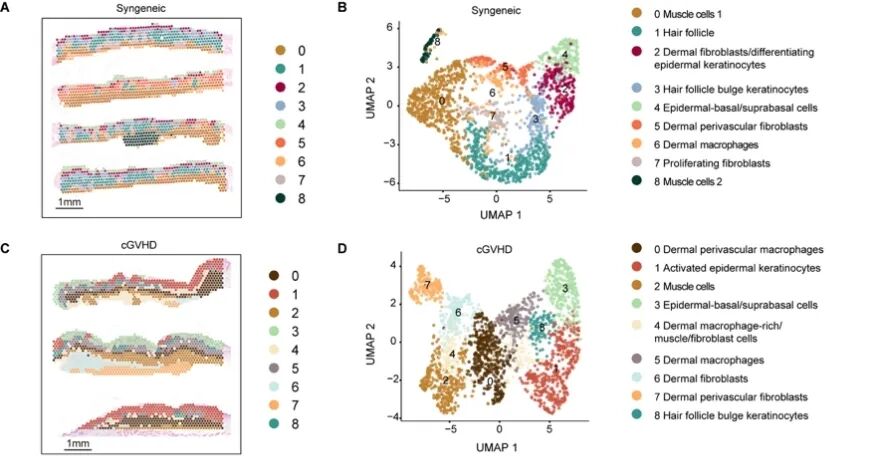
▲ Cutaneous cGVHD is accompanied by extensive immune microenvironmental stress plastic
Discovery 1: Hypoxia is not a "result", but an "engine" for the continued development of the disease"
For a long time, it was generally believed that hypoxia was merely a secondary manifestation of tissue inflammation and injury. However, this study found that in cutaneous cGVHD, hypoxia is far more than just a "trace" left by the disease, but an important driving force that maintains the progression of the disease. The research team used spatial transcriptome, single-cell sequencing and patient skin biopsy to systematically characterize the skin cGVHD immune microenvironment. Revealing that hypoxia occurs throughout the entire process of disease development, this discovery changes the traditional understanding that hypoxia is not a passive result after tissue damage, but an active factor driving the continued development of skin cGVHD.
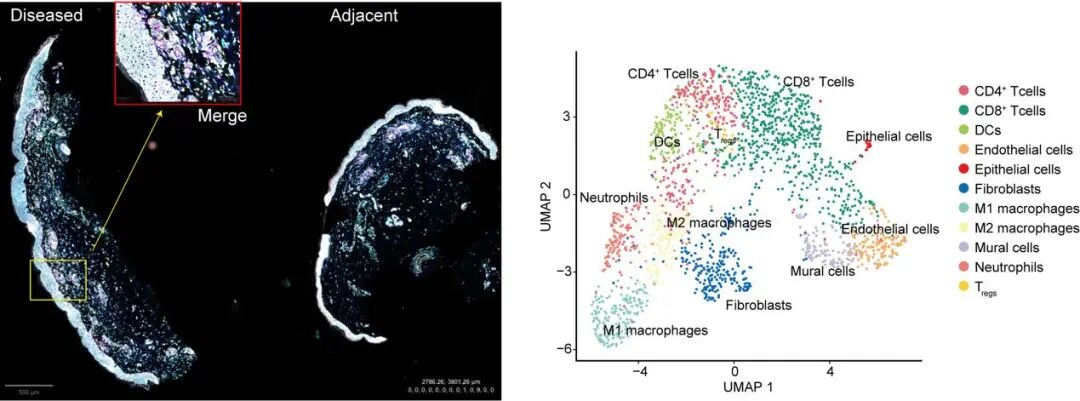
▲cGVHD skin forms local ectopic tertiary lymphoid structures
Discovery 2: Why can’t skin fibrosis stop?
Further research found that what really makes the disease progress is not a single cell, but a positive feedback network that continues to strengthen itself. The research team discovered for the first time that a new TLS-like structure composed of CD4⁺ T cells, macrophages and fibroblasts was formed within skin lesions. Different from the classic Tfh and B cell interaction structure in lung cGVHD, this structure becomes an important tissue basis for maintaining local chronic inflammation.
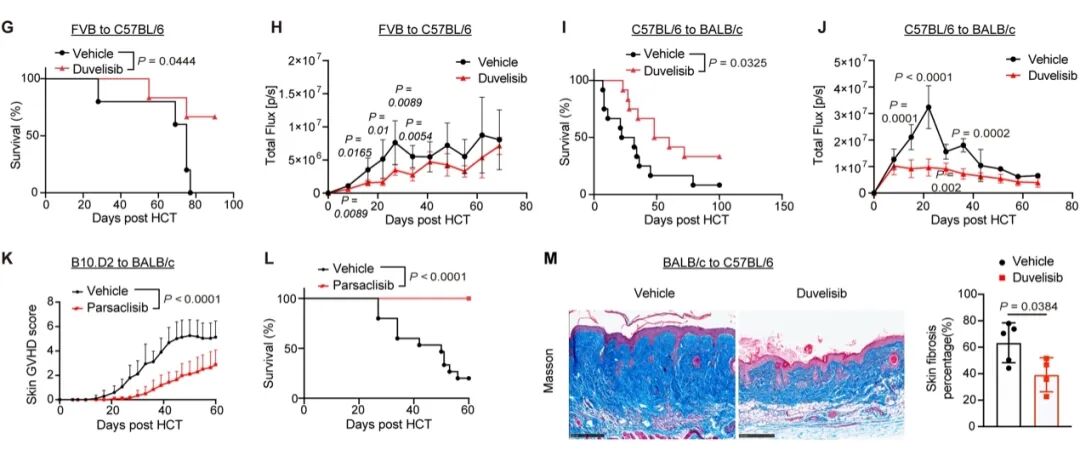
▲PI3K inhibitor treatment reduces cGVHD
Discovery 3: If you find the "switch", you have a chance to block skin fibrosis
Since hypoxia relies on this feedback network to be maintained, can this cycle be interrupted? The research results give a positive answer. Regardless of inhibiting HIF-1α, applying PI3Kδ inhibitors, or neutralizing IL-13, they can significantly reduce local hypoxia levels, reduce the formation of TLS-like structures, weaken abnormal communication between immune cells and stromal cells, and significantly improve fibrosis and survival outcomes in multiple skin cGVHD mouse models.
The biggest innovation of this study is not only the discovery that hypoxia is involved in disease progression, but more importantly, it redefines the pathological role of hypoxia in cutaneous cGVHD—hypoxia is not an accompanying phenomenon after tissue damage, but a core driving factor that can actively shape the immune microenvironment, maintain chronic inflammation, and sustain fibrosis. The study established the "HIF-1α–PI3Kδ–IL-13" positive feedback network and proposed a new model of continuous interaction of "T cells-macrophages-stromal cells", which provides a new theoretical framework for understanding the evolution of chronic GVHD from inflammation to fibrosis, and also provides an important basis for precise targeted treatments such as PI3Kδ.
Science Translational Medicine is an interdisciplinary integrative medical journal founded by the American Association for the Advancement of Science (AAAS) in October 2009. The journal focuses on the intersection of basic research, translational research and clinical practice, covering more than 20 medical directions such as cardiovascular disease, immunology, neuroscience, and cancer. It has an impact factor of 15.8 and is a TOP journal in the JCR Q1 area and the Chinese Academy of Sciences' medical category 1 area. 。
Click below to read the original text and access the original text link.
https://www.science.org/doi/10.1126/scitranslmed.adx7264

Number
023-68059937
Email:Jinfeng@jflab.ac.cn
Address:
No.313, Bella Road Chongqing High-tech Zone
Postal code: 401329

 渝公网安备50009802002274