
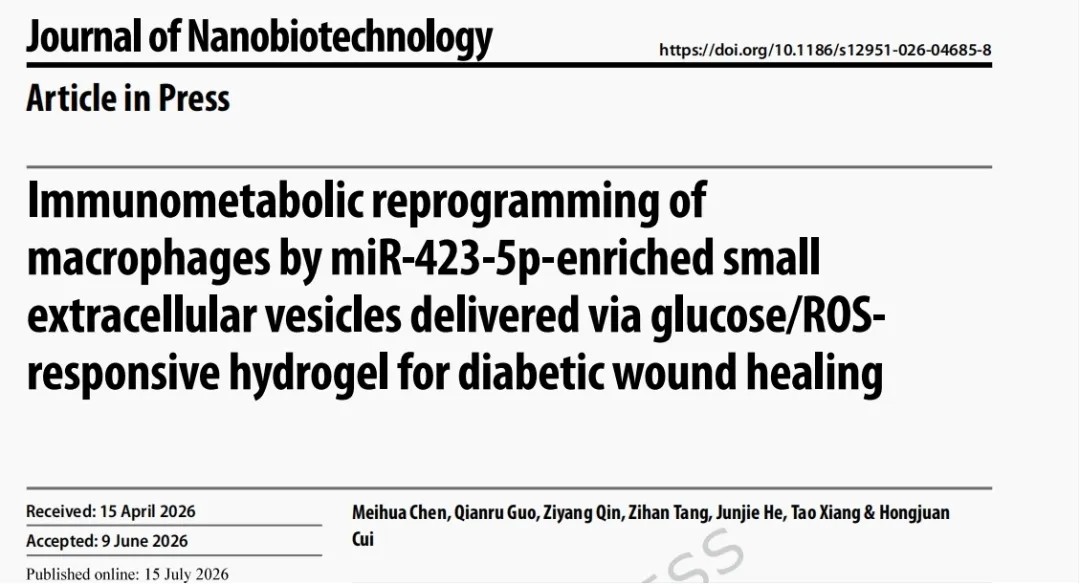
Technological innovation: Systematically screen the superior sources of external vesicles, identify a new axis of metabolic regulation of miR-423-5p/HDDC3/AMPK/mTOR, and construct a glucose/ROS dual-responsive hydrogel to achieve "on-demand release" of UCMSCs-EVs.
Inspired by the intersection of immunometabolic regulation and smart materials, the team systematically compared the repair efficiency of mesenchymal stem cell external vesicles from different sources for the first time and found that umbilical cord stem cell-derived external vesicles (UCMSCs-EVs) were significantly better than adipose stem cell-derived external vesicles (ADSCs-EVs) in driving macrophage M2 polarization and metabolic reprogramming. Through small RNA sequencing and functional verification, miR-423-5p was identified as a key effector molecule. It regulates the AMPK/mTOR pathway by targeting HDDC3, redirects macrophage metabolism from glycolysis to fatty acid oxidation, achieves a fundamental shift from pro-inflammatory to pro-repair phenotype, and accurately dismantles the vicious cycle of inflammation and metabolism from the root of metabolism.
In order to solve the delivery bottleneck of rapid clearance and low bioavailability of free EVs, the team constructed glucose/reactive oxygen species dual-responsive dynamic cross-linked hydrogels (DCH@EVs), which transformed the two pathological characteristics of high glucose and reactive oxygen stress in diabetic wounds into triggering conditions for hydrogel dissociation, achieving in situ on-demand release of EVs in the wound. The cumulative release of EVs is positively correlated with glucose and reactive oxygen species concentrations, achieving local concentration maintenance and microenvironment-responsive release of therapeutic EVs.
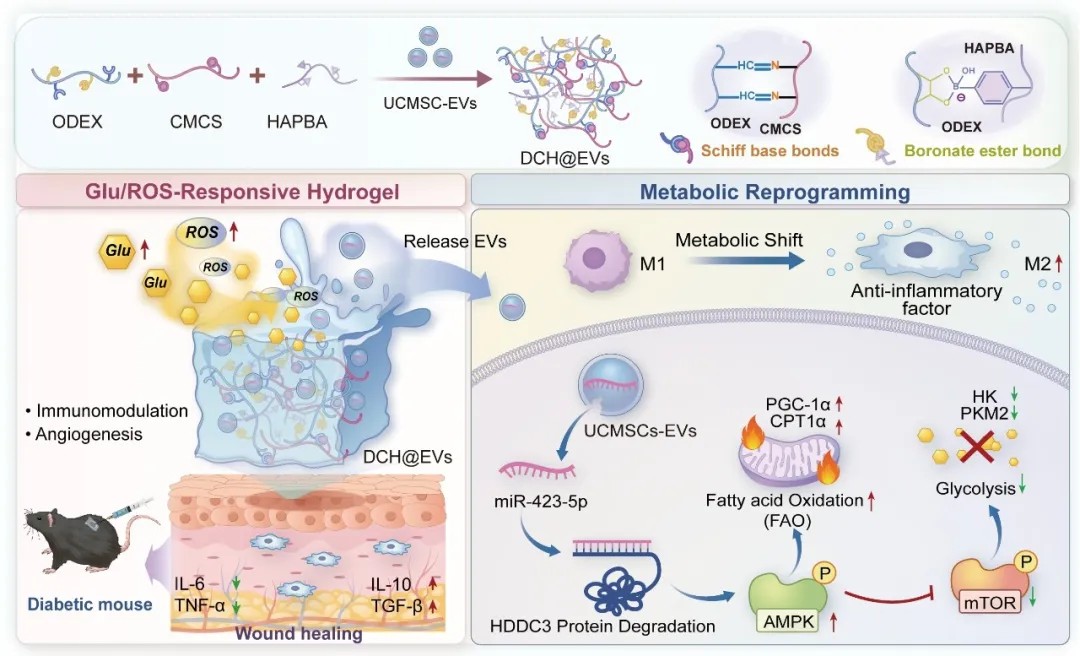
▲ Schematic diagram of the healing process of diabetic wounds treated with DCH@EVs hydrogel
Core Discovery 1: System Screening Select and determine UCMSCs-EVs as the optimal source, and identify miR-423-5p/HDDC3/AMPK/mTOR as the key metabolic regulatory axis
The research team systematically compared the efficacy of UCMSCs-EVs and ADSCs-EVs in diabetic wound repair for the first time. In vitro experiments show that UCMSCs-EVs are significantly better than ADSCs-EVs in promoting endothelial cell tube formation, cell migration and driving macrophage M2 polarization. ; In the diabetic mouse model, the wound healing rate of the UCMSCs-EVs treatment group reached 79.87%, while the ADSCs-EVs group was only 68.35%, confirming the superiority of UCMSCs-EVs. Through small RNA sequencing, it was found that miR-423-5p was highly enriched in UCMSCs-EVs, and functional verification confirmed that it was a core effector molecule. Mechanistic studies have shown that miR-423-5p directly targets and inhibits HDDC3, thereby activating AMPK and inhibiting mTOR signaling, redirecting macrophage metabolism from glycolysis to fatty acid oxidation, and achieving a transition from a pro-inflammatory M1 to a pro-repair M2 phenotype. HDDC3 overexpression completely reversed the above effects, confirming the functional necessity of this signaling axis.
Core findings two :Build Glucose/ROS dual-responsive hydrogel delivery system enables in-situ on-demand release and collaborative treatment of EVs in wounds
In order to solve the delivery bottleneck of rapid clearance of free EVs, the team constructed a dynamic double-cross-linked hydrogel based on oxidized dextran, carboxymethyl chitosan and phenylboronic acid-modified hyaluronic acid. When the volume ratio of ODEX/CMCS/HA-PBA is 20:100:167, the system has both suitable storage modulus and injectability, as well as shear thinning and self-healing properties, and can adapt to irregular wounds. In the microenvironment of high glucose and high reactive oxygen species in diabetic wounds, the boronic ester bonds and Schiff base bonds in the system are selectively broken, driving hydrogel dissolution and EVs release, and the amount of release is positively correlated with glucose and reactive oxygen species concentrations. In the diabetic mouse model, the wound healing rate of the DCH@UCMSCs-EVs group reached 96.61%, which was significantly higher than the 80.47% of the free EVs group and 74.90% of the hydrogel alone group.
Therapeutic advantages: Metabolic reprogramming + microenvironmental response release, synergistically promotes diabetic wound healing
In the full-thickness skin defect model of diabetic mice, the wound healing rate of the DCH@UCMSCs-EVs hydrogel group reached 96.61%, which was significantly better than the 80.47% of the free EVs group and 74.90% of the hydrogel alone group. Histological analysis showed that the regenerated epidermis in this group was complete, new hair follicles were abundant, and collagen deposition was orderly. The above results show that hydrogel-mediated local sustained release of EVs effectively breaks the vicious cycle of inflammation and metabolism in diabetic wounds through the synergistic effect of scavenging reactive oxygen species and metabolic reprogramming, and creates a favorable regenerative microenvironment for wound healing.
Prospects for clinical translation: Engineered EVs open up a new path for cell-free treatment of chronic wounds
The EVs protocol used in this study has the advantages of naturally low immunogenicity and avoids transformation risks such as low survival rate and difficult to control phenotype in living cell therapy. The miR-423-5p/HDDC3/AMPK/mTOR metabolic regulatory axis identified by the study provides a clear functional enhancement target for EVs engineering. This mechanism is universal and can be used to prepare engineered miR423-5p-EVs and extend it to chronic inflammatory diseases such as arthritis, atherosclerosis, and fibrosis of various organs.
The Journal of Nanobiotechnology is a high-level open access (OA) biology journal published by BioMed Centra, a subsidiary of Springer Nature, focusing on cutting-edge research at the intersection of nanoscience and biomedicine. The impact factor in 2026 is 15.0, JCR partition Q1.
Click below to read the original text and access the original text link.
https://doi.org/10.1186/s12951-026-04685-8

Number
023-68059937
Email:Jinfeng@jflab.ac.cn
Address:
No.313, Bella Road Chongqing High-tech Zone
Postal code: 401329

 渝公网安备50009802002274