
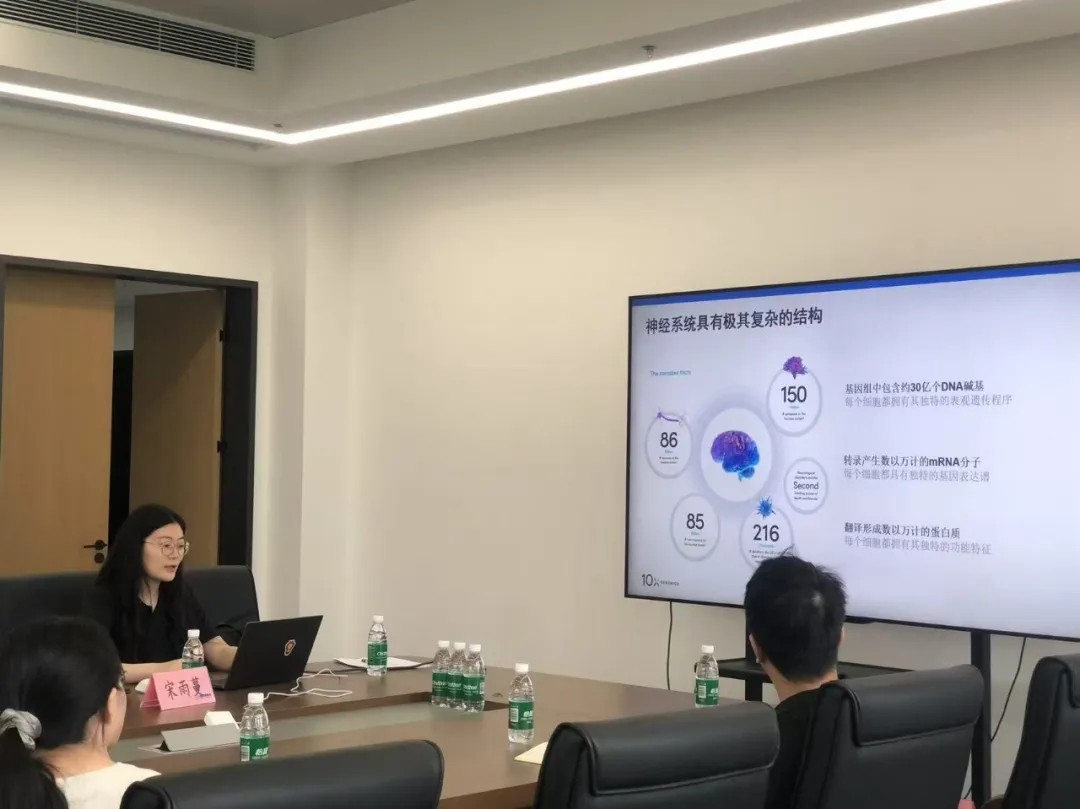
On May 28, 2026, the first phase of Jinfeng Interdisciplinary Academic Lectures was successfully held. This meeting focused on new generation Discussion on cutting-edge technologies of single-cell sequencing and spatial omics. The event specially invited Song Yuman, a technical expert from 10x Genomics, to focus on the development trends and implementation examples of single-cell sequencing, spatial transcriptomics and new spatial biology technologies, to explain in detail the new generation of single-cell multi-omics technology, and to help the application of this technology in the fields of neuroscience, oncology, and translational medicine. Laboratory researchers, platform technical backbones, and teachers and students from various research groups participated in the meeting for exchanges and discussions.
Introduction to the speaker
Song Yuman , 10x Genomics technical expert, has focused on 10x Genomics single cell and spatial transcriptome technical support and application services in the past five years, and is mainly responsible for single cell scientific research technical support in Southwest China. Familiar with Chromium, Visium, Xenium and other platforms, able to assist scientific research users in carrying out technical exchanges and project support related to single cells and spatial omics.
Key points of the lecture
This lecture First, focusing on the development status of single-cell omics and spatial biology technology, the technology iteration path was systematically sorted out: from traditional Bulk RNA-seq to gradually developing to single-cell transcriptome (Single-cell), spatial transcriptome (Spatial) and in situ spatial detection technology (In Situ), and focused on comparing the technical characteristics and applicable scenarios of different levels of omics technologies. Subsequently, the speaker combined multiple high-level research cases of neurological diseases to demonstrate the application value and breakthrough research progress of single-cell technology in analyzing disease mechanisms. Research cases include: relying on single-nucleus RNA sequencing technology (snRNA-seq) to analyze cell type-specific changes in brain tissue of patients with autism spectrum disorder (ASD) and clarify the abnormal characteristics of cortical neurons and microglia. ; Explore the neuroimmune activation mechanism induced by mutant huntingtin protein (mHTT) in Huntington's disease (HD) through single-cell transcriptome and epigenomics combined analysis technology ; At the same time, the latest application progress of single-cell ATAC-seq technology in the study of genetic risk sites for Alzheimer's disease (AD) and Parkinson's disease (PD) is introduced.
This lecture broadened scientific researchers' understanding of cutting-edge technologies in single cells and spatial omics, provided reference for multi-omics integration and high-resolution spatial biology research, and helped various research groups and platforms in the laboratory deepen scientific research collaboration and enable clinical transformation.


Number
023-68059937
Email:Jinfeng@jflab.ac.cn
Address:
No.313, Bella Road Chongqing High-tech Zone
Postal code: 401329

 渝公网安备50009802002274