

Molecular classification of glioma plays a key role in diagnosis, treatment decision-making, and prognosis assessment. In recent years, with the update of the fifth edition of the World Health Organization classification of central nervous system tumors, IDH mutations, 1p/19q Key molecular events such as co-deletion, TERT promoter mutation, and gain of chromosome 7 with deletion of chromosome 10 (+7/-10) have become important basis for accurate diagnosis of glioma. However, current molecular typing testing relies heavily on time-consuming and expensive technologies such as gene sequencing, fluorescence in situ hybridization, and immunohistochemistry, which are often difficult to implement in resource-limited environments. Therefore, how to achieve fast, accurate, and low-cost molecular variation prediction from routine tissue pathology sections has become an important direction in pathological AI research.
The study included a total of 4024 glioma patients and 6298 H&E full-field pathological slides from 14 independent cohorts, covering TCGA, EBRAINS databases and 12 domestic medical institutions. The research team built the GMAP model based on the pathological basic model UNI and GLTrans architecture, and used weakly supervised deep learning methods to predict IDH mutations, 1p/19q co-deletions, TERT promoter mutations and chromosome +7/-10 changes. At the same time, the study further conducted a comprehensive multi-scale interpretability analysis at three different levels: cell level, tissue level and slice level.
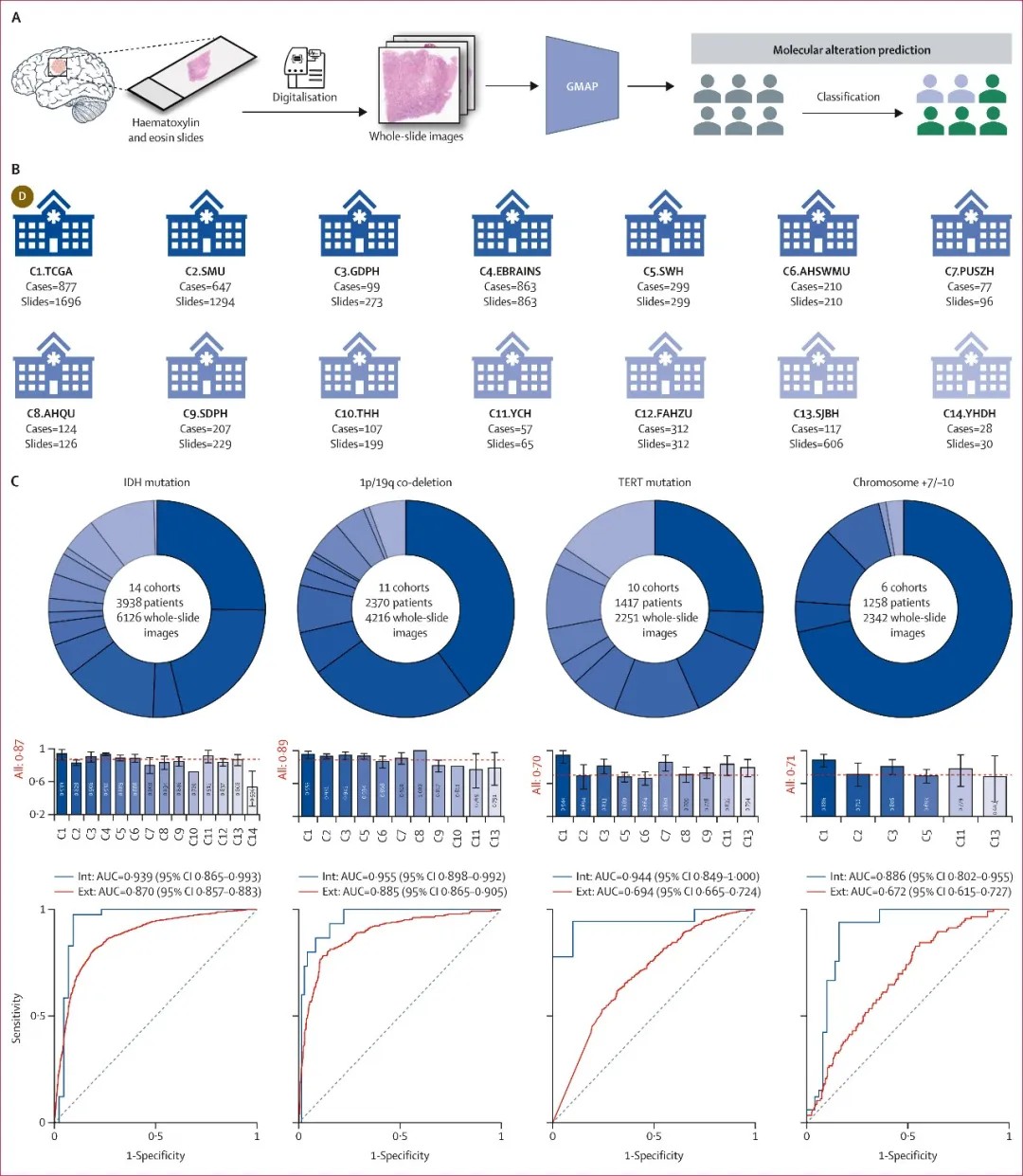
▲GMAP study design and validation
The results show that GMAP has superior performance in the internal test set: the area under the receiver operating curve (AUC) for predicting IDH reaches 0.939 (95% CI: 0.865–0.993), and the total deletion of 1p/19q reaches 0.955 (95% CI: 0.898–0.992), TERT promoter mutation reaches 0.944 (0.849–1.000), +7/-10 change reaches 0.886 (0.802–0.955). In external validation from 12 medical institutions and public data sets, IDH and 1p/19q co-deletion prediction still maintained high performance, with AUC reaching 0.870 (95% CI 0.857–0.883) and 0.885 (0.865–0.905) respectively, demonstrating good cross-center generalization ability. Interpretability analysis showed that the morphological features that GMAP focuses on include both known molecular variation-related features and previously unrecognized features. In addition, the model's attention heat map is highly consistent with the corresponding immunohistochemical staining results, further enhancing the credibility of the model's predictions.
In short, this study developed and multi-center verified the intelligent diagnostic model GMAP for molecular classification of brain glioma, providing a technically feasible solution that can achieve accurate, rapid and potentially cost-effective molecular variant identification in a resource-limited environment. At the same time, the interpretability reveals the characteristics of the model's focus, increases the credibility of the model in clinical application, and lays an important foundation for the clinical promotion and translational application of AI pathology.
"The Lancet Digital Health" is a sub-journal of the top international medical journal "The Lancet". It was founded by Elsevier in May 2019. It focuses on interdisciplinary research on digital technology and medical health, covering cutting-edge fields such as artificial intelligence-assisted diagnosis, digital medical equipment, wearable technology, telemedicine, big data analysis, and intelligent analysis of medical imaging. 。
Click below to read the original text and access the original text link.
https://authors.elsevier.com/sd/article/S2589-7500(25)00159-1


Number
023-68059937
Email:Jinfeng@jflab.ac.cn
Address:
No.313, Bella Road Chongqing High-tech Zone
Postal code: 401329

 渝公网安备50009802002274