
Recently, Professor Zheng Hui from the team led by Academician Yang Zhenglin at the Sichuan Academy of Medical Sciences & Sichuan Provincial People’s Hospital, as well as the Jinfeng Laboratory, published a research paper in the internationally renowned journal *Cell* (IF=42.5). The title of the paper is…“ Pyruvate is a natural suppressor of interferon signaling by inducing STAT1 protein pyruvylation ”Breakthrough research papers. This study reveals that the metabolite pyruvate is a natural inhibitor of interferon signaling, providing a new mechanism for understanding how high blood sugar weakens the antiviral immune response.
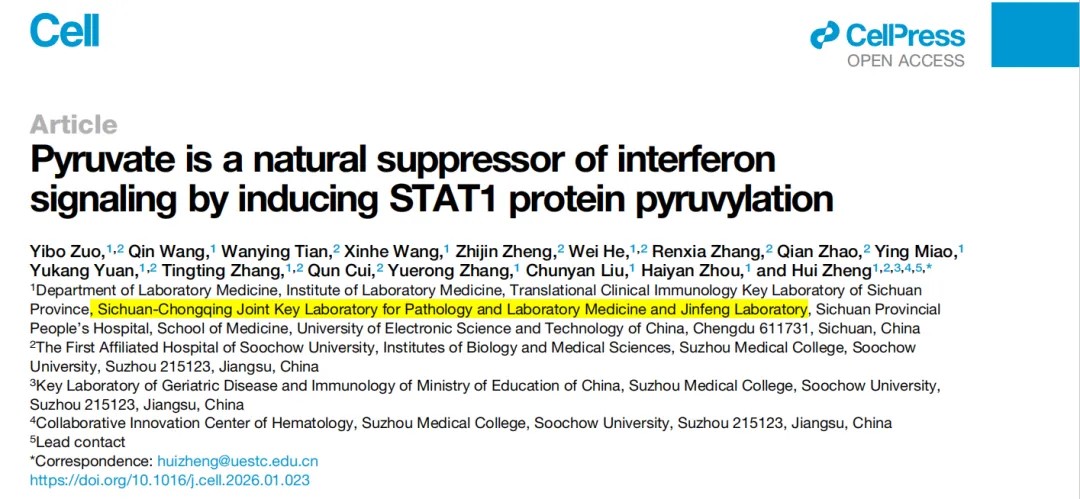
People with high blood sugar have weakened antiviral immunity and are more likely to develop severe clinical symptoms after being infected with the virus. This phenomenon has a widespread impact on the health of individuals with elevated blood sugar levels and endangers the lives of patients with severe clinical conditions. However, the precise mechanism by which high blood sugar levels reduce the body's antiviral immunity remains unclear to this day.
As a highly conserved metabolic pathway in living organisms, the metabolite pyruvate played a crucial role in processes such as energy metabolism and cellular homeostasis. This study found that pyruvate, the end product of glycolytic metabolism, is able to significantly inhibit the signaling pathway of Type-I Interferon (IFN-I), thereby reducing the body’s antiviral immune defense mediated by IFN-I. At the same time, this study reported for the first time in the international community a new type of post-translational protein modification – protein pyruvation modification. It was found that pyruvate can act as a small molecule donor and covalently bind to STAT1, a key signaling protein in the IFN-γ signaling pathway, thereby forming the STAT1 protein pyruvation modification. The pyruvation modification of STAT1 protein inhibits its binding to STAT2, thereby suppressing the transmission of the IFN-γ signaling pathway and ultimately reducing the intensity of the IFN-γ signal. Under high-sugar conditions, the pyruvation modification of STAT1 protein in the body increases significantly, thereby weakening the body's antiviral immunity mediated by IFN-I.
It is worth emphasizing that this study, through a series of in-depth investigations, found that many proteins within cells can undergo protein pyruvate modification, indicating that this type of modification is a widespread post-translational modification in living organisms. Therefore, in the future, in-depth analysis of the pyruvate modification of key proteins that regulate physiological or pathological functions is expected to provide a scientific basis for a comprehensive understanding of the body's physiological processes and the development of diseases. It may also lead to new strategies for the treatment of clinical disorders.
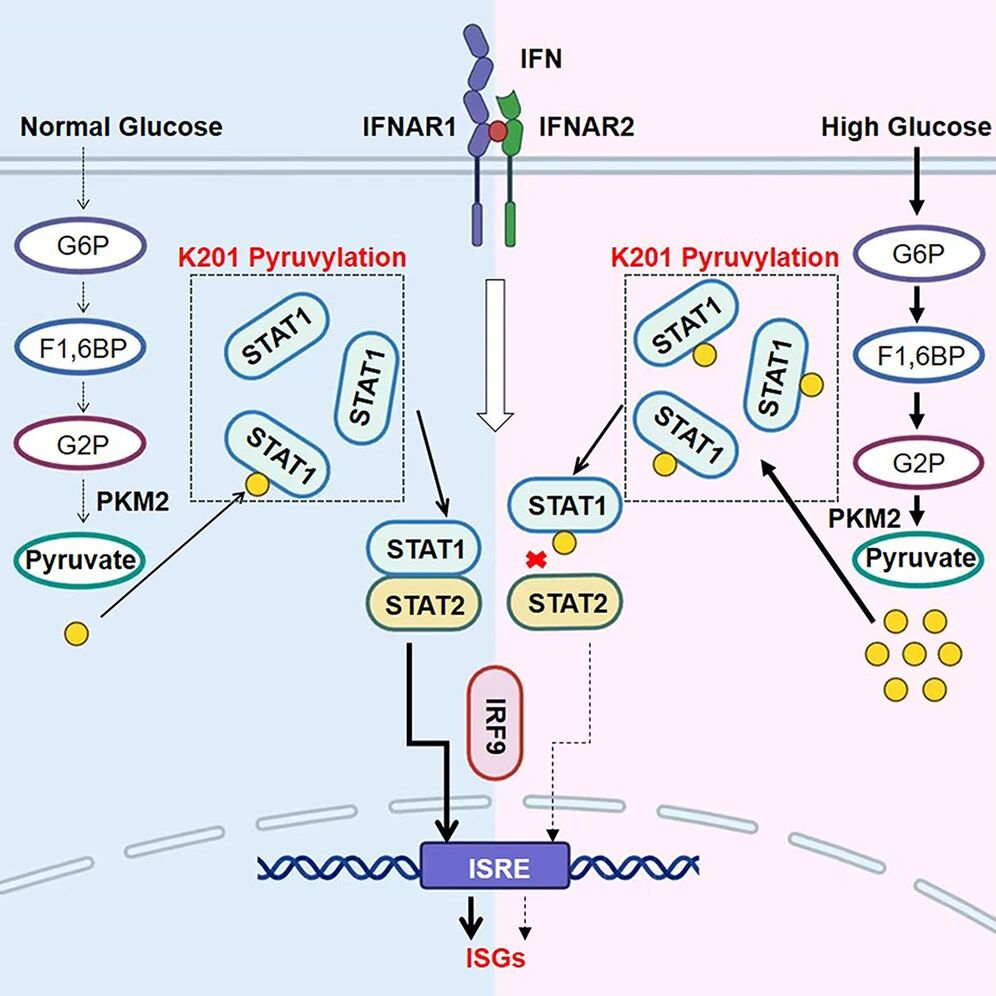
▲Protein pyruvation is a post-translational modification that can regulate immune signaling and the host's antiviral response.
Cell was first published in 1974, and its current impact factor is 42.5, placing it in the Q1 category of the JCR. This journal is dedicated to publishing high-quality research that represents significant conceptual breakthroughs in the field of biology, or that raises important and thought-provoking biological questions. It covers a wide range of disciplines including cell biology, molecular biology, neuroscience, immunology, and more. Along with Nature and Science, it is considered one of the three top academic journals worldwide.
Click “Read the original text” in the lower left corner to visit the link to the original article.


Number
023-68059937
Email:Jinfeng@jflab.ac.cn
Address:
No.313, Bella Road Chongqing High-tech Zone
Postal code: 401329

 渝公网安备50009802002274