
Recently, the team of Academician Bian Xiuwu and Professor Wang Bin of Jinfeng Laboratory/Army Medical University jointly published a research review titled "Cancer cachexia: molecular basis and therapeutic advances" in the journal Signal Transduction and Targeted Therapy. It systematically elaborated on the molecular basis and treatment progress of cancer cachexia, pointing out that this syndrome, which affects about 50%-80% of cancer patients, is not a local lesion, but a systemic metabolic inflammatory disorder driven by the dynamic interaction between the tumor and the host's multiple organs.
Cancer cachexia is a common complication in patients with malignant tumors, with an incidence rate as high as 50%-80%. It is especially common in patients with solid tumors such as pancreatic cancer, gastric cancer, and lung cancer. Its typical manifestations are persistent weight loss (≥5% loss within 6 months), muscle atrophy and adipose tissue consumption, leading to reduced tolerance to chemotherapy and shortened survival by 20%-30%. It is worth noting that Asian populations tend to mask fat loss due to their high BMI, and there is an urgent need to optimize diagnostic criteria based on lean body mass and other indicators.
The research team proposed that cachexia is affected by Systemic metabolic disorders and chronic inflammation are synergistically driven, expanding the traditional understanding of "local effects of tumors", emphasizing the development mechanism of multiple organ interactions such as "gut-brain axis, liver-muscle dialogue, skeletal muscle-fat axis, neural regulation", and mapping the three major mechanisms of "glycolytic conversion, lipid metabolism imbalance, and amino acid competition" Metabolic map of cachexia dominated by substance-critical disorders.
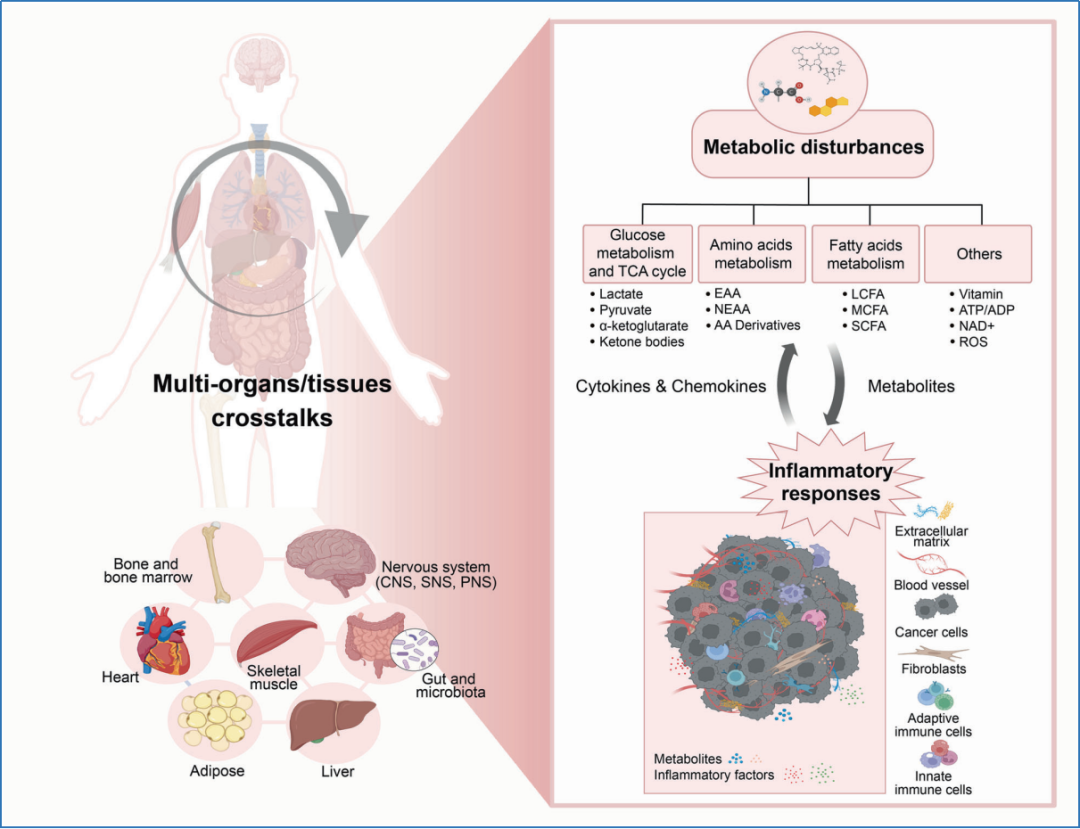
▲Global regulatory model of "metabolic reprogramming and inflammatory response" in organ dialogue in cancer cachexia
They proposed a paradigm change in the field of cancer cachexia research, that is, from a single perspective of "muscle atrophy" to a systemic perspective of "multi-organ interaction". New mechanisms and treatment strategies are expected to extend patients' survival and improve their quality of life. In the future, it is necessary to develop animal models that are closer to human pathophysiology (such as organoids, patient-derived xenografts), pay attention to the role of neuro-metabolism-epi interactions in cachexia, and develop new intervention strategies that combine immunotherapy, metabolic regulators and personalized nutritional therapy.
"Signal Transduction and Targeted Therapy" was founded in 2016. It is a journal managed by Springer Nature and sponsored by Springer Nature & West China Hospital of Sichuan University (impact factor 52.7, top journal in the first region of the Chinese Academy of Sciences). The journal focuses on signal transduction mechanisms and targeted therapy research in physiological and pathological processes, covering tumors, autoimmune diseases and other diseases, and mainly publishes original research, reviews and clinical cutting-edge progress articles.
Click on the lower left to read the original text and access the original text link.


Number
023-68059937
Email:Jinfeng@jflab.ac.cn
Address:
No.313, Bella Road Chongqing High-tech Zone
Postal code: 401329

 渝公网安备50009802002274