
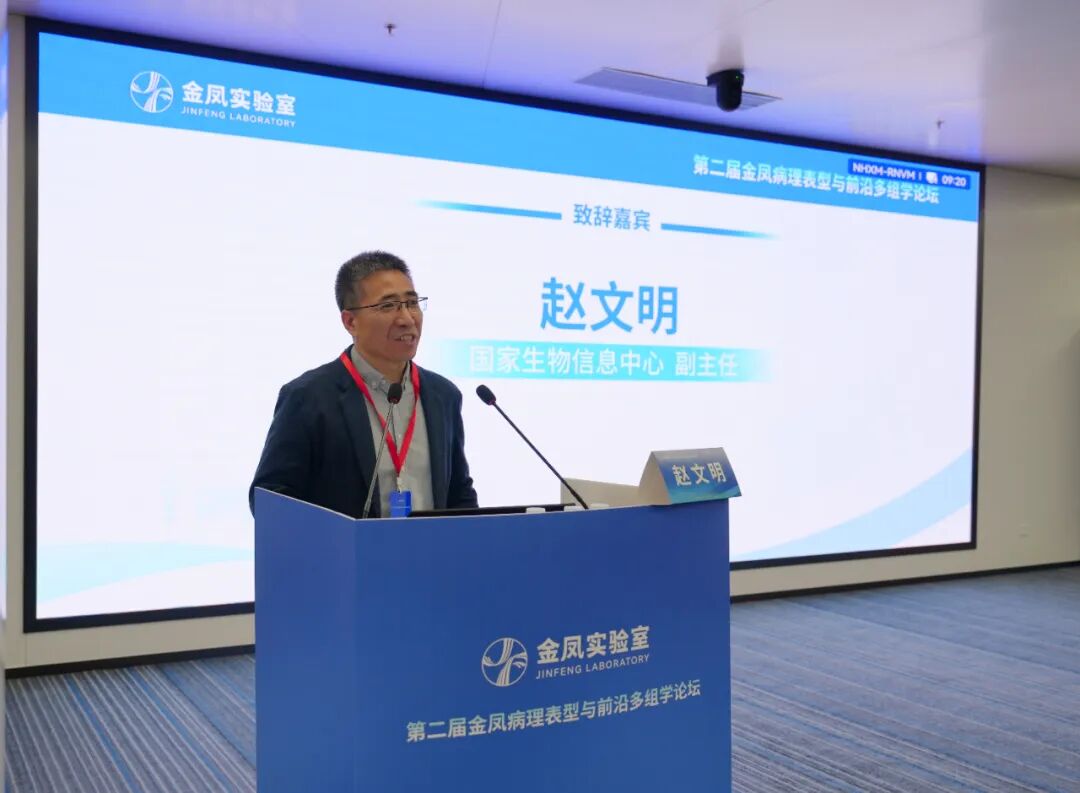
On December 19, 2025, the "Second Jinfeng Pathological Phenotypes and Frontier Multi-omics Forum" directed by the National Center for Bioinformatics and hosted by Jinfeng Laboratory was successfully held in Chongqing. More than 110 experts and scholars from domestic and foreign universities, research institutes and medical institutions gathered in the mountain city to discuss new paths for subject development. Xu Hui, deputy director of Jinfeng Laboratory, and Zhao Wenming, deputy director of the National Center for Bioinformatics, delivered speeches at the opening ceremony. The "National Genome Science Data Center Pathological Phenotype Data Sub-Center" was officially unveiled. Wang Zheng, director of the Biomedical Information Research and Application Center of Jinfeng Laboratory, presided over the opening ceremony.
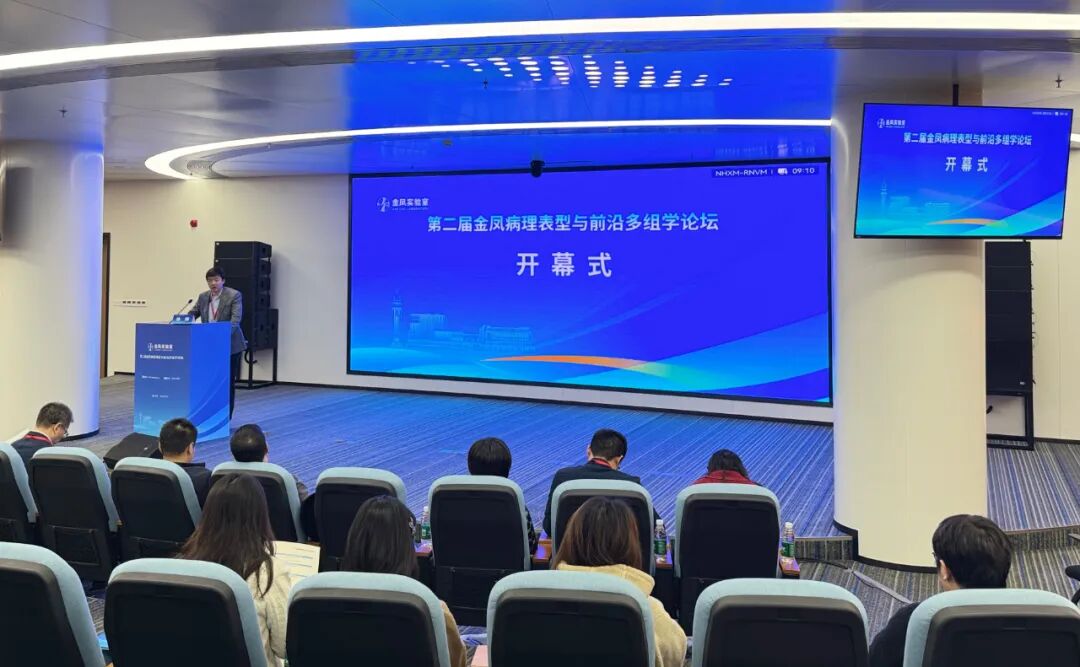
Deputy Director Xu Hui introduced that Jinfeng Laboratory, as a strategic scientific and technological force created by the Municipal Party Committee and the Municipal Government to implement the Chengdu-Chongqing Economic Circle Development Strategy, focuses on the core task of "next-generation diagnosis of major diseases" and has built 10 high-level scientific research platforms such as the pathological phenotyping platform. It has also achieved phased results in gathering high-level talent teams, conducting organized scientific research, promoting the transformation of scientific and technological achievements, and creating national strategic resources. The laboratory will give full play to the advantages of data collaboration and interdisciplinary collaboration to help enhance the national biomedical strategic resource support capabilities. Deputy Director Zhao Wenming said in his speech that the Jinfeng Laboratory Biomedical Information Research and Application Center has joined the National Genome Science Data Center system, which is an important measure for the integration and sharing of pathological phenotype data resources across the country. It will promote the in-depth connection between the pathological phenotype database system and regional scientific research needs, provide more efficient and reliable data support for national scientific research teams, promote data integration analysis, joint technical research and the cultivation of comprehensive talents, and inject strong impetus into scientific and technological innovation in the field of life and health in my country.
This forum covers multiple dimensions from basic research to clinical translation. Focusing on intelligent computing and medical transformation, Professor Yang Yuedong of Sun Yat-sen University and Professor Xu Yungang of Xi'an Jiaotong University respectively elaborated on the new bioinformatics method of super-intelligence fusion and the transformation system from biological big data to drug design. ; In the direction of radiomics and spatial technology, Professor Chen Wei from the First Affiliated Hospital of Army Medical University and Jinfeng Laboratory and Professor Cao Gang from Shenzhen University of Technology demonstrated the innovative application of multi-modal intelligent diagnosis and spatial multi-omics technology. ; Regarding artificial intelligence and precision diagnosis, researcher Yu Weimiao from the Singapore Institute of Bioinformatics, Professor Jin Cheng from Shanghai Jiao Tong University, Professor Lei Boying from Shenzhen University, and researcher Cui Yingbo from the National University of Defense Technology respectively discussed the cutting-edge progress of AI interpretability, new imaging research paradigms, precision tumor diagnosis and multi-omics data mining. ; In terms of disease mechanisms and intervention strategies, researcher Zhao Huiying from Sun Yat-sen Memorial Hospital of Sun Yat-sen University, researchers Zhang Weiqi and Tian Chenxi from the National Center for Bioinformatics, and professor Hu Yanling from Guangxi Medical University presented systematic research results from the perspectives of medical big data, aging mechanisms, tumor microenvironment and epigenetic regulation. ; In addition, researcher Chen Hebing from the Academy of Military Medical Sciences and professor Yu Guoxian from Shandong University also introduced the innovative applications of artificial intelligence in gene regulation analysis and causal learning in biomedicine.
The guests also visited Jinfeng Laboratory and learned about the laboratory's achievements in technology research and development, platform construction, and achievement transformation, which laid a solid foundation for subsequent exchanges and cooperation.
This forum takes the construction of the Pathological Phenotype Data Sub-Center of the National Genome Science Data Center as an opportunity to promote the in-depth integration of pathology, multi-omics, bioinformatics and artificial intelligence, and provides a high-level communication platform for scholars in the field. In the next step, Jinfeng Laboratory will closely follow the country's major strategic needs, give full play to the role of the platform hub, promote the construction of a cross-regional, cross-disciplinary, and cross-institutional data collaboration and innovation system, promote the high-quality development of multi-omics research on pathological phenotypes, and help Chongqing accelerate the creation of a life and health science and technology innovation highland.


Number
023-68059937
Email:Jinfeng@jflab.ac.cn
Address:
No.313, Bella Road Chongqing High-tech Zone
Postal code: 401329

 渝公网安备50009802002274