
Lecture Review
Application Study of Functional Nucleic Acid Nanomedicine in Acute Lung Injury ARDS
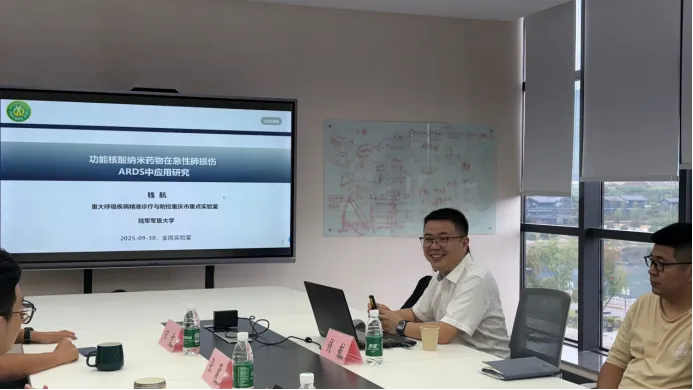
Biography of the speaker
Qian Hang , Researcher, Doctoral Supervisor, Deputy Director of the Chongqing Key Laboratory of Precision Diagnosis and Prevention of Major Respiratory Diseases, Member of the Geriatrics Committee of the Chongqing Society of Integrated Traditional Chinese and Western Medicine, Doctor jointly trained by Xiamen University and Purdue University in the United States, and Postdoctoral Fellow at the National University of Singapore. Mainly engaged in research on the delivery of nucleic acid nanomaterial drugs for the prevention and treatment of major respiratory diseases such as lung injury/ARDS and lung cancer, as well as their underlying mechanisms. Selected for the Chongqing Middle and Young Medical High-end Talent Project (2021) ; Won 1 second prize of Chongqing Natural Science Award ; Has been approved for seven projects funded by the National Natural Science Foundation of China and the Chongqing municipal projects ; As the first/corresponding author (including co-authors) in Chem. Soc. Rev., Adv. Funct. Materials, Small, Biomaterials, Bioactive Materials, Chemistry, Science, Advances More than 30 papers have been published in mainstream SCI journals such as Healthc. Mater., with a cumulative impact factor of 302.4 ; Four national invention patents have been authorized ; Serves as a communications editor for the electronic version of the "Chinese Journal of Pulmonary Disease" and "Journal of Clinical Laboratory Medicine", and as a communications reviewer for the National Natural Science Foundation, Nat. Reviewer for journals such as Commun., Adv. Sci., etc.
Main content
The lecture first analyzed the treatment challenges of ARDS. As a high mortality acute diffuse inflammatory lung injury, its pathophysiological core is excessive inflammatory response, making precise inhibition of the inflammatory cascade a key therapeutic strategy. However, there is currently a lack of specific drugs targeting the etiology in clinical practice, and existing mainstream anti-inflammatory regimens such as glucocorticoids and IL-6 receptor antagonists not only have limited efficacy but also carry the risk of immunosuppression. In addition to the widespread problems of low bioavailability and off-target toxicity in drug delivery, they collectively constitute the current treatment bottleneck. Therefore, the development of a novel therapeutic platform that can achieve targeted delivery and simultaneously exert multiple mechanisms of action has become an urgent clinical need.
Subsequently, the lecture focused on exploring the potential of DNA nanocarriers as a solution to overcome this dilemma. DNA nanocarriers inherently possess multiple advantages such as programmable targeting, co-loading of genes/drugs, and ROS clearance. It is worth noting that the lecture pointed out the limitations of traditional magnesium ion-dependent DNA assembly methods in terms of enzymatic stability and functionalization, and introduced an innovative strategy as a result: Constructing functional composite nanocarriers through "non-traditional" assembly of DNA mediated by endogenous biomacromolecules. This strategy shows significant potential in enhancing targeting, achieving responsive release, and enabling synergistic therapy.


Number
023-68059937
Email:Jinfeng@jflab.ac.cn
Address:
No.313, Bella Road Chongqing High-tech Zone
Postal code: 401329

 渝公网安备50009802002274