
Recently, Professor Zhang Jianxiang's team from the Army Military Medical University and the Chongqing-Guangdong Pathology Research Center was launched in international journals Bioactive Materials A review paper titled "Advanced nanotherapies for precision treatment of inflammation lung diseases" was published on this.
Globally, acute inflammatory diseases of the lung (such as pneumonia, acute lung injury and acute respiratory distress syndrome) are still important clinical challenges leading to high morbidity and high mortality. Especially in the post-epidemic era, severe cases caused by lung infection and inflammation continue to occur, while the effects of existing drug treatment plans are still insufficient and are often accompanied by obvious side effects. Clinical urgently requires more accurate, efficient and safe innovative treatment strategies. In recent years, the rapid development of nanomedicine has brought a new perspective to addressing this challenge. Based on the pathological microenvironment unique to acute lung inflammation - such as inflammatory factor storms, abnormal infiltration of immune cells, oxidative stress microenvironment, etc., a series of "intelligent" nanocarriers that can respond to lesion signals are designed to achieve the accurate release and efficient accumulation of drugs in the inflammatory sites. These advanced nanotherapies show great potential. This paper systematically reviews the pathogenic mechanism and pathological microenvironment of acute lung inflammation, comprehensively analyzes the design principles and application prospects of a variety of bioresponsive nanocarriers (especially inflammation-responsive nanotherapy), and focuses on the breakthrough progress of bionic nanotechnology such as cell membrane coating and extracellular vesicles. Finally, forward-looking solutions are proposed to address the key challenges facing the clinical transformation of next-generation nanotherapy, pointing out the direction for future research.
This article not only provides a comprehensive review of existing research, but also provides clear direction and feasibility suggestions for the clinical transformation path of next-generation nanotherapy technologies, helping to better implement nanomedicine in the treatment of respiratory diseases.
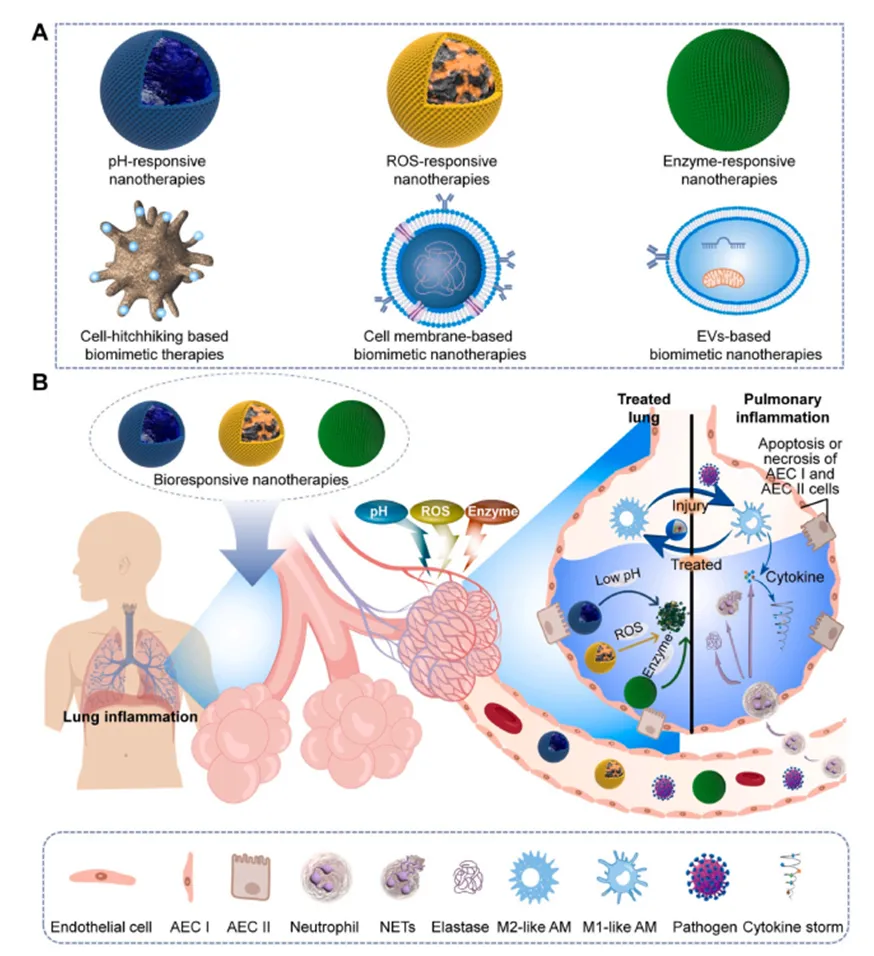
▲Schematic diagram of different biological responses and bionic nanotherapy and its application in the treatment of acute lung inflammation
Bioactive Materials is an internationally authoritative journal focusing on the field of bioactive materials. It was founded in 2016 and published by Elsevier. The latest impact factor of the journal is 20.3, and it is listed as Top journals in both the Engineering Zone 1 of the Chinese Academy of Sciences and the JCR Q1 section. The journal mainly publishes original research in the fields of biologically active metals and alloys, biologically active inorganic substances, biologically active polymers and gels, covering all aspects of biologically active materials and is an authoritative platform for scientific researchers in this field to publish cutting-edge results.
Click on the lower left to read the original text and access the original text link.
https://pubs.acs.org/doi/10.1021/acsnano.5c02492


Number
023-68059937
Email:Jinfeng@jflab.ac.cn
Address:
No.313, Bella Road Chongqing High-tech Zone
Postal code: 401329

 渝公网安备50009802002274